 Add to Chrome
 Add to Firefox
 Add to Edge
Rethinking Positional Encoding for Neural Vehicle Routing
May 12, 2026
Transformer-based models have become the dominant paradigm for neural combinatorial optimization (NCO) of vehicle routing problems (VRPs), yet the role of positional encoding (PE) in these architectures remains largely unexplored. Unlike natural language, where tokens are uniformly spaced on a line, routing solutions exhibit several properties that render standard NLP positional encodings inadequate. In this work, we formalize three such structural properties that a routing-aware PE should respect, namely anisometric node distances, cyclic and direction-aware topology, and hierarchical depot-anchored global multi-route structure, combining them with a unifying design principle of geometric grounding. Guided by these criteria, we analyze and compare PE methods spanning NLP, graph-transformer, and routing-specific families, and propose a hierarchical anisometric PE that combines a distance-indexed, circularly consistent in-route encoding with a depot-anchored angular cross-route encoding. Extensive experiments across diverse VRP variants demonstrate that geometry-grounded PE consistently outperforms index-based alternatives, with gains that transfer across problem variants, model architectures, and distribution shifts.

VRPAgent: LLM-Driven Discovery of Heuristic Operators for Vehicle Routing Problems
Oct 08, 2025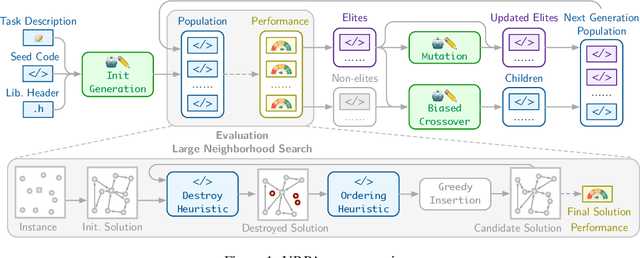
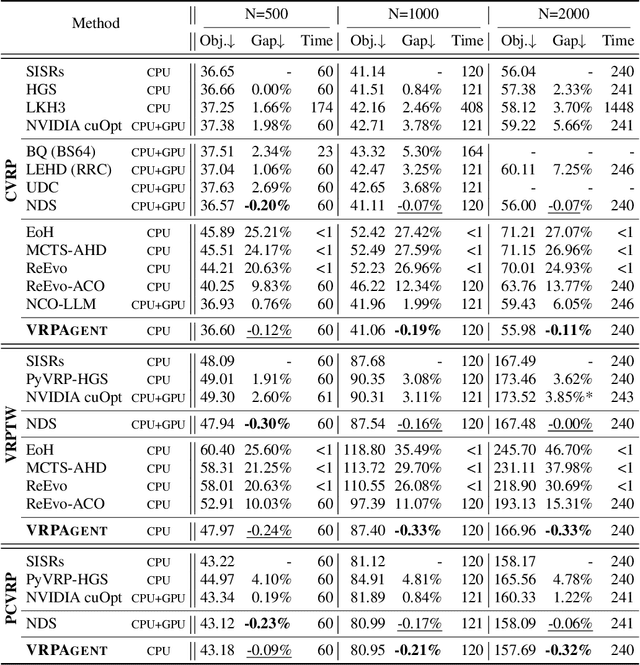
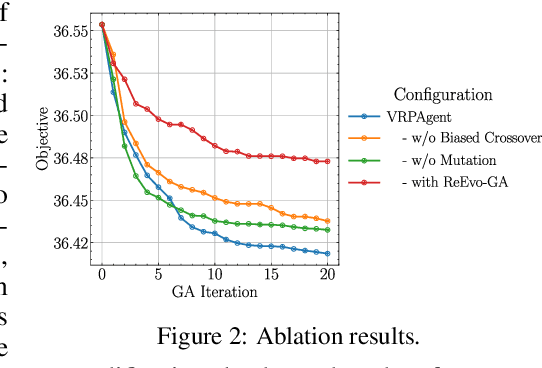
Designing high-performing heuristics for vehicle routing problems (VRPs) is a complex task that requires both intuition and deep domain knowledge. Large language model (LLM)-based code generation has recently shown promise across many domains, but it still falls short of producing heuristics that rival those crafted by human experts. In this paper, we propose VRPAgent, a framework that integrates LLM-generated components into a metaheuristic and refines them through a novel genetic search. By using the LLM to generate problem-specific operators, embedded within a generic metaheuristic framework, VRPAgent keeps tasks manageable, guarantees correctness, and still enables the discovery of novel and powerful strategies. Across multiple problems, including the capacitated VRP, the VRP with time windows, and the prize-collecting VRP, our method discovers heuristic operators that outperform handcrafted methods and recent learning-based approaches while requiring only a single CPU core. To our knowledge, \VRPAgent is the first LLM-based paradigm to advance the state-of-the-art in VRPs, highlighting a promising future for automated heuristics discovery.
RouteFinder: Towards Foundation Models for Vehicle Routing Problems
Jun 21, 2024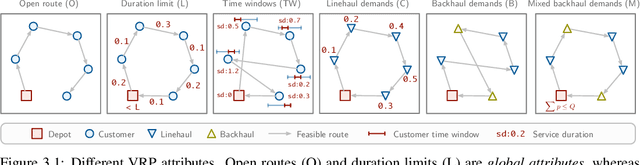
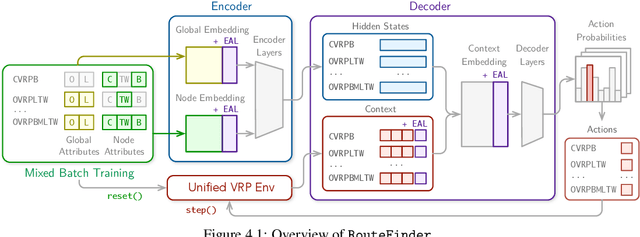
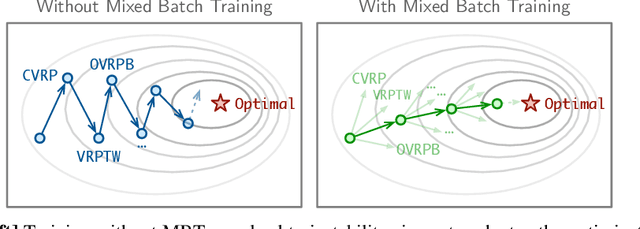
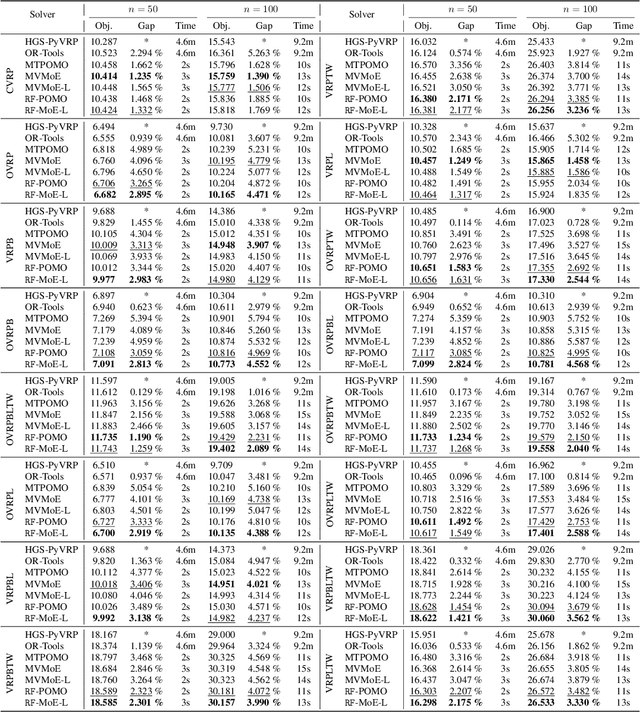
Vehicle Routing Problems (VRPs) are optimization problems with significant real-world implications in logistics, transportation, and supply chain management. Despite the recent progress made in learning to solve individual VRP variants, there is a lack of a unified approach that can effectively tackle a wide range of tasks, which is crucial for real-world impact. This paper introduces RouteFinder, a framework for developing foundation models for VRPs. Our key idea is that a foundation model for VRPs should be able to model variants by treating each variant as a subset of a larger VRP problem, equipped with different attributes. We introduce a parallelized environment that can handle any combination of attributes at the same time in a batched manner, and an efficient sampling procedure to train on a mix of problems at each optimization step that can greatly improve convergence robustness. We also introduce novel Global Feature Embeddings that project instance-wise attributes efficiently onto the latent space and help the model understand different VRP variants. Finally, we introduce Efficient Adapter Layers, a simple yet effective technique to finetune pre-trained RouteFinder models to solve novel variants with previously unseen attributes outside of the original feature space. We validate our approach through extensive experiments on 24 VRP variants, demonstrating competitive results over recent multi-task learning models. We make our code openly available at https://github.com/ai4co/routefinder.